Understanding Texas Growing Zones: What Lone Star State Gardeners Need to Know for a Thriving Landscape
Everything's bigger in Texas – even the amount of growing zones! If you're a Lone Star gardener, understanding Texas growing zones will help your plants thrive.


Texas growing zones are unusual in that there are five USDA plant hardiness zones across the state: 6, 7, 8, 9, and 10. It’s necessary to understand your particular zone because the elevation changes and different ecoregions just within Texas can produce climates from arid deserts to the subtropics. It is important if you garden in these zones to learn how this information impacts the success of what you plant.
The USDA planting zones divide the country into thirteen different planting zones. Each 10-° zone specifies the average annual extreme minimum winter temperature that a plant can tolerate and still come back the next year (Click on USDA planting zones for a map). Each zone is further divided into 5-° increments, which are designated as A and B, and are not shown on this map.
The USDA zones are often printed on plant tags for your use. For example, if a tag says the perennial plant is hardy to zone 7 and you live in zone 8, the plant should return for you next year provided its other necessary growing conditions are met. But if you live in zone 5, it would be wise to choose another plant. Understanding your Texas planting zone will help you choose appropriate plants that will thrive year after year.
Click on the image below to see a larger version of the West Texas map. For a larger version of the East Texas map, click here.
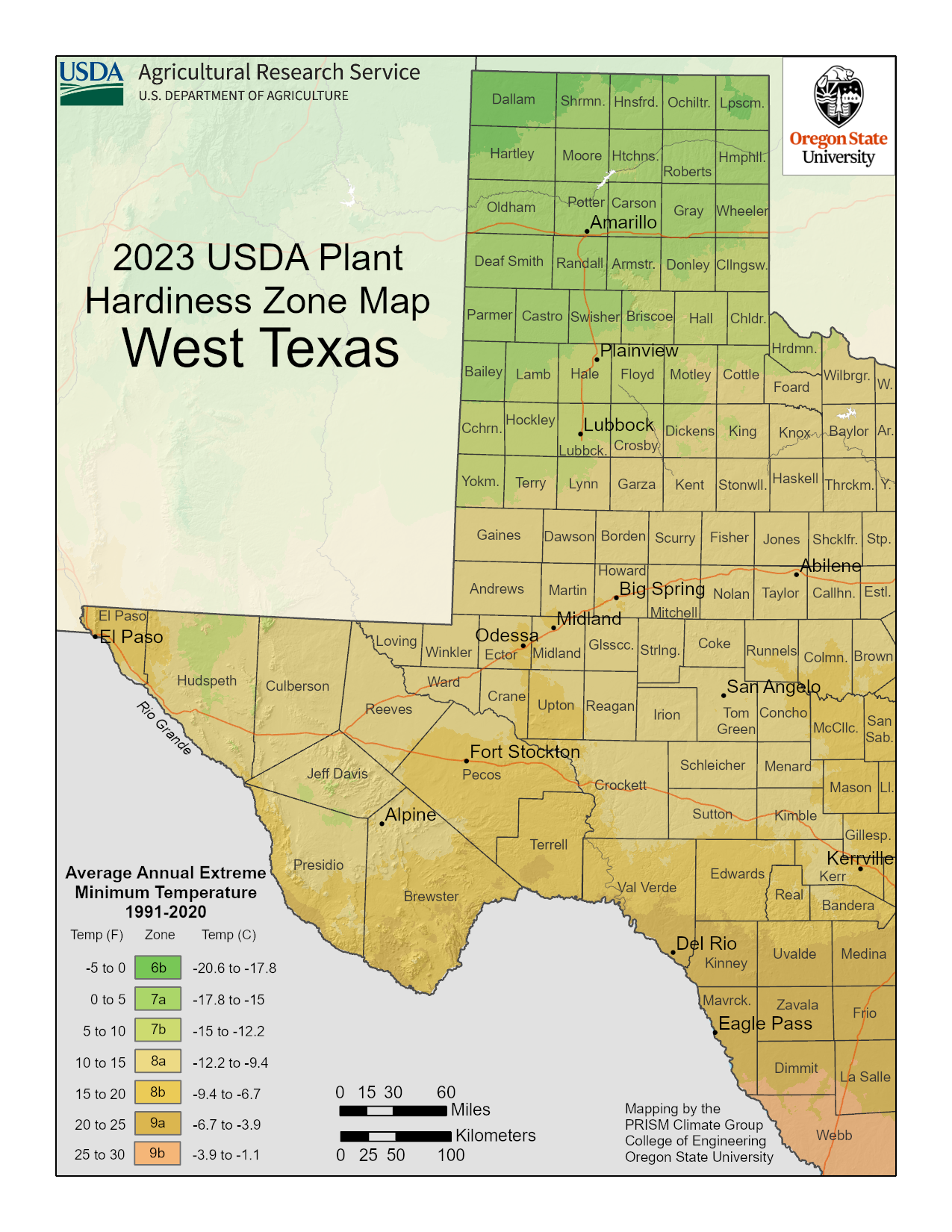
Understanding the USDA Zone Map
The latest USDA plant hardiness map from 2023 is an upgrade from the old 2012 map, which was not nearly as sophisticated as the new map. Changes to the hardiness zones take into consideration more factors such as elevation, proximity to a large body of water, and urban heat.
Although the Texas zone map is not always a guarantee that plants will survive, it does provide a very strong framework for planning a garden. Other factors may come into play when considering the success or failure of a particular shrub, flower, or tree. Those include planting location, soil condition, and humidity.
Once you have purchased a plant that is suitable for your growing region, be sure to follow the planting care instructions carefully. If you move to a new growing zone, even within the state of Texas, be sure to learn about your new hardiness guidelines for a successful garden.

Growing Zones in Texas
Texas is divided into several different USDA zones ranging from 6b to 10a. Here are the winter temperature extremes and ideas for Texas garden plants that thrive in each of the planting zones in the Lone Star State.
Zone 6b
In zone 6b, which has winter lows ranging from -5 to 0°F (-20.6 to -17.8°C), plants should be able to withstand temperatures down to -5°F during the winter months and return the next spring.
Plants that should thrive in this northern Texas zone include the native plants like the American beautyberry shrub, false indigo, red yucca, Texas rock rose, bee balm, coral honeysuckle, and passion vine.

Zone 7
Zone 7, which has winter lows ranging from 0 to 10°F (-17.8 to -12.2°C), covers parts of the Texas panhandle, including dryland and rolling plains. Plants should be able to survive temperatures down to 0°F and still return in the spring.
Plants that should thrive include the native plants American beautyberry, Texas betony, skullcap, mealycup sage, Gregg’s mistflower, frogfruit, cedar sage, Turk’s cap lily, and flame acanthus.
Zone 8
Zone 8, which has winter lows as cold as 10 to 20°F (-12.2 to -6.7°C), spans western Texas (arid, dry), central Texas (diversified dryland) and eastern Texas (good rains, humid summers). Plants should be able to withstand winter temperatures down to 10°F and return in spring.
Native plants that do well in this zone include American beautyberry shrub, flame acanthus, 'Lynn’s Legacy' cenizo, red yucca, Texas lantana, Texas sage, Turk’s cap, cedar sage, lyreleaf sage, Texas verbena, coral honeysuckle, and Gulf muhly grass.

Zone 9
Zone 9, which experience winter temperatures between 20 to 30°F (-6.7 to -1.1°C), includes coastal and southern Texas. These areas have sandy soil and long, humid summers. Plants should be able to withstand winter temperatures down to 20°F and still come back in spring.
Native plants for this zone include firebush, flame acanthus, 'Gold Star' esperanza, red yucca, Texas lantana, Texas sage, Turk’s cap, cedar sage, mealycup sage, Texas verbena, coral honeysuckle, and Gulf muhly grass.
Zone 10a
In zone 10a, which has a subtropical environment, winter lows only get down to 30 to 35°F (-1.1 to 1.7°C). Plants should be able to withstand temperatures to 30°F during the winter months and still return the next spring.
Native plants that do well in this climate include American beautyberry, flame acanthus, red yucca, Texas lantana, Texas rock rose, Texas sage, cedar sage, mealycup sage, coral honeysuckle, and Lindheimer’s muhly grass.

Texas Regions
Beyond the USDA hardiness zones, the Texas AgriLife Extension divides the state into seven regions based on climate and soil type:
- Region A: Panhandle and High Plains
- Region B: North and Central Texas
- Region C: Northeast and East Texas
- Region D: West Texas
- Region E: Upper Rio Grande
- Region F: Hill Country and Central Coast
- Region G: Southeast Texas
- Region H: Rio Grand Valley
Their Earth-Kind® Plant Selector allows you to find plants suitable for these regions. In addition, Texas Superstar® Plants are jointly selected by Texas plant experts to recommend annuals, perennials, woody shrubs, trees, fruits and vegetables that excel in the Lone Star State.
Top Tools for Texas Gardeners

If you're growing in cooler zones, these floating plant covers from Amazon are an affordable way to trap heat and protect your plants against frost and wind.

This portable mini greenhouse from Amazon is great for starting seedlings indoors or protecting plants outdoors in cold zones, especially for smaller spaces.

In warmer zones, it is well worth setting up an irrigation system, like this Rain Bird drip irrigation kit from Amazon to keep plants hydrated in the Texas summer heat.
