






6 Tough Trees That Can Handle Whatever the Weather Throws at Them
You don't have to sacrifice good looks to get a tree that will survive all the wild weather we get. All these beauties are as tough as they come…


As our weather gets wilder, we need to be choosing trees that are tougher, and resilient enough to stand up to whatever the climate has in store. Trees that rebound from a period of bad weather with branches that don’t snap in a strong breeze, trees that won’t faint on a hot day or wilt in a drought.
We all treat our garden trees like pets when we first plant them, catering to their needs with stakes and regular watering. And that's fine – all trees need our help until they grow their roots deep enough to be secure in their new home, and find their own moisture. But after a time, landscape trees have to be able to deal with the elements by themselves, from high winds to drought to cold weather. Because who wants to be forever wrapping their trees in plant cover?
The predicted super El Niño event means we're likely in for a rough ol' ride of weather, and who knows how the climate may change in future, so if you're planting a tree this year, make sure it's a tough, future-proof beauty. Are there attractive trees that don’t need coddling? Indeed there are, and here's our shortlist of favorite tough trees for backyards of all sizes.
1. Crape Myrtle

If you think tough trees aren't going to be gorgeous, think again. A close look at crape myrtle (Lagerstroemia indica) may change your mind on that topic forever. Gorgeous, when it comes to trees, means showy flowers, attractive bark, and brilliant fall color. Crape myrtles have it all.
Come early summer, their branches are overloaded with colorful blossoms in unbelievable shades of pink, red, and purple summer flowers. Fall brings fiery foliage, then winter reveals fabulous, exfoliating bark. And they come in sizes ranging from 3-foot (1 meter) shrubs to trees that are 30 feet (10m) tall. This makes it easy to pick a tree by mature size, depending on the dimensions of your garden.
As for resilience, that all part of the crape myrtle package. These pretty trees are tough. Crape myrtle is hardy down to USDA hardiness zone 6, and such a drought-tolerant tree that, once established, only requires irrigation twice a month. They're incredibly wind-resistant, too, with flexible branches and a low center of gravity.
Nature Hills Nursery stocks a good selection of smaller crape myrtle cultivars, including Black Diamond Purely Purple, which has deep purple blooms and dramatic black foliage.
2. Serviceberry

Serviceberry (Amelanchier spp.) is one of the most underrated native trees in the country. It’s exceptionally beautiful, produces delicious berries both your family and your wild birds will adore, and is tough as nails. Serviceberry trees are resilient natives, growing from 15 to 30 feet (5-10m) tall. They shrug off strong winds, clay soil, cold winters and late spring frosts, thriving in USDA hardiness zones 2–9.
As spring arrives, serviceberry trees fill their branches with airy white flowers. They blossom earlier than most flowering plants, which means that serviceberries provide spring pollinators with critical nectar supplies when other food is scarce.
When this spring show comes to a close, the next act is sweet summer berries that grow in pink and ripen to deep purple. Fall brings brilliant color with red, gold, and orange leaves. Then, in winter, the elegant structure of the branches and beauty of the smooth, gray-striped bark emerges.
Serviceberry trees are available from Jackson & Perkins.
3. Eastern Red Cedar

Eastern red cedar ((Juniperus virginiana) is a native evergreen tree that could have 'tough' as its middle name. It's a dependable tree that's drought tolerant and resistant to extremes of heat and cold. It copes in a wide range of soil from swamps to rocky, barren soil. And the strong wood, deep roots, and compact crown shape help it weather any wind that blows by. These trees are cold hardy to USDA hardiness zone 2.
An attractive tree by any standard, Eastern red cedar has blue-green, scale-like leaves and red-brown exfoliating bark. It offers food and shelter to wildilfe, its blue fruits consumed by birds and a wide variety of animals. Planted in full sun and well-drained soil, this juniper will eventually grow to 30 feet (10 meters) high.
Trees are available from Nature Hills Nursery.
4. Flowering Dogwood

Do you want a small tree that will bring exceptional four-season interest to your backyard? Then the flowering dogwood (Cornus florida) might be the tree of your dreams. The spring bract flowers fill the branches with incredible clouds of white, pink, or red blossoms. In summer, you’ll enjoy the deep green foliage that turns brilliant orange and wine-red in fall.
Flowering dogwood typically grows from 10 to 30 feet (3-10m) tall. It's a beautiful and versatile tree and loves a location near river banks or streams. The trees are very resistant to winds – often called hurricane-resistant trees – because of their strong wood structure and compact size.
White Flowering Dogwood is available from Nature Hills Nursery.
5. Dwarf Alberta Spruce

‘Conica’ is a slow-growing variety of Alberta spruce that is cold hardy, thriving in USDA hardiness zones 3 through 6. This slow-growing evergreen looks just like a Christmas tree, topping out at 13 feet (4m) tall at full maturity – and it will take years and years to get that high. Conica (Picea glauca var. albertiana 'Conica') has dense, attractive foliage that makes an excellent privacy screen in the garden.
Don't let its delicate looks deceive you because this bright-green spruce is very resilient, remarkably hardy and needs little maintenance. Once established, it tolerates both wet and dry sites, enjoys cold winters and is drought tolerant. It’s a very elegant tree without any hassle at all, a tree you will enjoy for years.
Dwarf Alberta Spruce is available from Fast Growing Trees.
6. Sand Live Oak
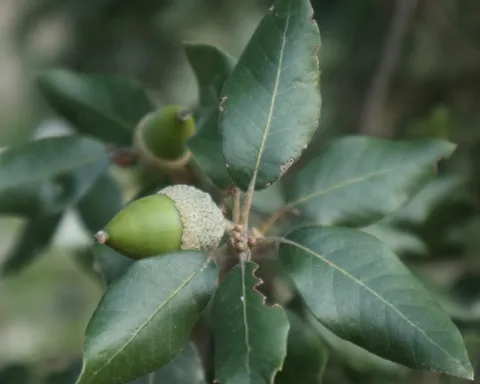
The sand live oak (Quercus geminata) is one tough, heat-tolerant tree. It’s an evergreen oak tree native to the coastal regions of the southeastern United States, known for its drought tolerance and ability to thrive in sandy soil. It has thick, leathery leaves, deeply furrowed bark, and a spreading canopy year-round, and will eventually grow to 20 to 30 feet (7–10m) tall.
Sand live oak is also known for its resistance to hurricane-force winds, thanks to its strong, deep root system, flexible wood and low center of gravity. This tree thrives in USDA hardiness zones 7–10.
